


15000 Forint – Hungary
Non-circulating coins
Commemoration: 200th anniversary of writing the Hungarian Hymnus
Context
Year: 2023
Issuer: Hungary 
Issuing organization: Magyar Pénzverő
Period:
(since 1989)
Currency:
(since 1946)
Total mintage: 5,000
Material
References
Numista: #353823
Value
Exchange value: 15000 HUF = $46.96
Bullion value: $79.90
Inflation-adjusted value: 18751.80 HUF
Obverse
Inscription:
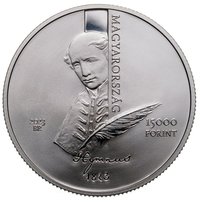
A Hymnus megírásának bicentenáriumára készült emlékérme előoldalán Kölcsey Ferenc félalakos portréja látható, amint előlép az előoldal megosztott hátteréből. A portrét AntonEinsle 1835-ös festménye ihlette. Az ábrázolás finoman utal arra az elvonultságra, amelyben a Hymnus született Szatmárcsekén. Kölcsey ruházatába rejtve olvasható a költő vezetékneve. Az ábrázolás alatt egy korabeli toll utal Kölcsey szerzőségére. Alatta két sorban a Hymnus eredeti kéziratából vett cím első szava – a „Hymnus” –, valamint a cím végén olvasható, a mű keletkezését megörökítő „1823”-as évszám szerepel. A portrétól jobbra függőlegesen a „MAGYARORSZÁG” felirat áll. Az előoldal alsó harmadában bal szélen két sorban a „2023” verési évszám, valamint a „BP.” verdejel, jobb szélen a „15000”, értékjelzés, valamint a „FORINT” felirat olvasható
Translation:
On the obverse of the commemorative coin issued for the bicentenary of the writing of the Hymn, a half-length portrait of Ferenc Kölcsey is visible, as he steps forward from the divided background of the obverse. The portrait was inspired by Anton Einsle's 1835 painting. The depiction subtly alludes to the seclusion in which the Hymn was born in Szatmárcseke. Hidden within Kölcsey's clothing, the poet's surname can be read. Below the depiction, a period quill alludes to Kölcsey's authorship. Beneath it, in two lines, are the first word of the title – "Hymnus" – taken from the original manuscript of the Hymn, as well as the year "1823", found at the end of the title, which records the year the work was created. To the right of the portrait, the inscription "MAGYARORSZÁG" is positioned vertically. In the lower third of the obverse, on the left edge in two lines are the mint year "2023" and the mint mark "BP."; on the right edge are the denomination "15000" and the inscription "FORINT".
Script: Latin
Language: Hungarian
Designer: Tamás E. Soltra
Reverse
Inscription:
Az érme hátoldalán magyarországi körpanoráma látható, melyre – a költemény szakrális jellegére utalva – a szentháromságot szimbolizáló központi háromszögből három irányba sugarak vetülnek. A háromszög körül a Hymnusban megfogalmazott kérés, a „NYÚJTS FELÉJE VÉDŐ KART HA KÜZD ELLENSÉGGEL” felirat olvasható; az idézet végpontjait egy pont választja el. A körpanorámában középen lent Kölcsey Szatmárcsekén található sírhelye látható, amelyet Magyarország ikonikus tájegységeinek ábrázolásai vesznek körül. Az óramutató járásával megegyező sorrendben ezek az alábbiak: Tihany, a Balaton, Szigliget, Esztergom, a Dunakanyar, Visegrád, Eger, Tokaj és Szatmárcseke. Az emlékérméket tervező Soltra E. Tamás szobrász- és éremművész mesterjegye Tokaj ábrázolásába rejtve jelenik meg.
Translation:
On the reverse of the coin, a panorama of Hungary is visible, upon which – alluding to the sacred character of the poem – rays are cast in three directions from the central triangle symbolizing the Trinity. Around the triangle, the plea formulated in the Hymn, the inscription "STRETCH A PROTECTIVE ARM TOWARDS HIM IF HE FIGHTS AGAINST A FOE" is legible; the endpoints of the quotation are separated by a dot. In the circular panorama, in the center below, Kölcsey's grave in Szatmárcseke is visible, which is surrounded by depictions of iconic landscape units of Hungary. In clockwise order, these are the following: Tihany, Lake Balaton, Szigliget, Esztergom, the Danube Bend, Visegrád, Eger, Tokaj, and Szatmárcseke. The master mark of the sculptor and medalist Tamás E. Solt, the designer of the commemorative coins, appears hidden within the depiction of Tokaj.
Script: Latin
Language: Hungarian
Designer: Tamás E. Soltra
Edge
Plain
Categories
| Art> Literature |
Mints
| Name | Mark |
|---|---|
| Hungarian mint | BP. |
Mintings
| Year | Mint Mark | Mintage | Quality | Collection |
|---|---|---|---|---|
| 2023 | BP. | 5,000 | Proof |
💎 Extremely Rare